
AIM Research · specialised in data and AIIndependent · Analyst-led · Vendor-neutral

    Market · Platforms · Tracked since 2026

    Data + AI Platform Providers

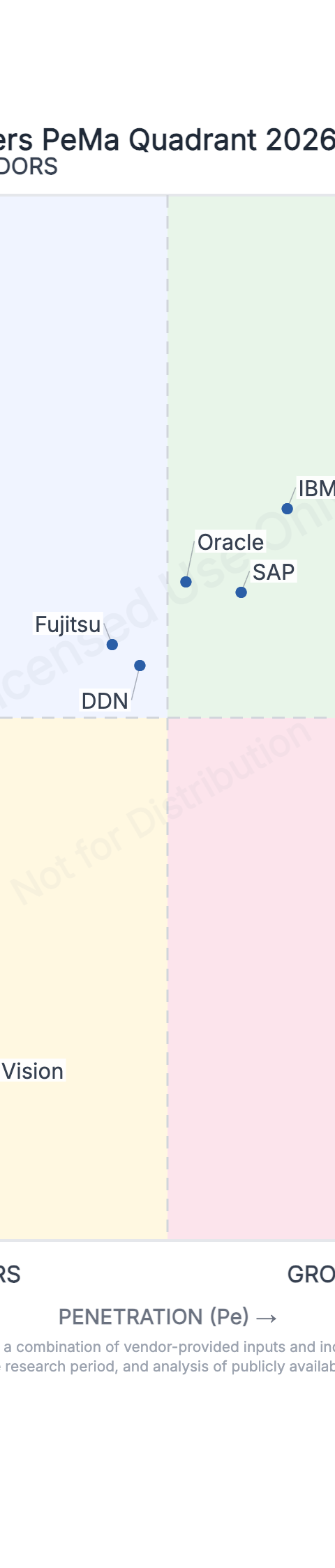
    16 vendors evaluated in the 2026 PeMa Quadrant, 7 of them Leaders.

    16

    Vendors tracked

    1

    PeMa edition

    1

    Current reports

    7

    Leaders today

    PeMa Quadrant

    The market, year by year

    Press play to watch vendors move from the first study to today. Yellow trails show where each vendor came from.

    SeasonedLeadersChallengersGrowth
    DDN
    Fujitsu
    BDB.AI
    NewFangled Vision
    Infoveave
    ILUM
    SAP
    Polestar Analytics
    Snowflake
    Formcept
    IBM
    Oracle
    Dataiku
    Spoggle
    Databricks
    Microsoft
    2026

    Movers in 2026

    First edition

    Movement shows from the second edition on.

    Quadrant mix · 2026

    7 Leaders · 4 Seasoned · 0 Growth · 5 Challengers

    Market intelligence · monthly brief

    This month in Data + AI Platform Providers

    The headline

    Platform vendors post strong results and push semantic layers into AI assistants

    Key takeaways

    1. 01

      Microsoft ships Fabric IQ in Copilot and new Fabric agents at FabCon Barcelona.

    2. 02

      Fujitsu refocuses Uvance on AI transformation and plans a new data and AI platform.

    3. 03

      Oracle Q1 FY27 revenue rises 30% to $19.35bn as RPO reaches $664bn.

    What it means for buyers

    For buyers, the month shows platform vendors competing on how well their semantic layers, governance and agent tooling work together. Strong results at Oracle and Snowflake suggest continued investment capacity, while Snowflake's convertible notes add to its balance sheet flexibility. Buyers should evaluate how each platform's semantic model is exposed to assistants and agents, how lock-in is managed across clouds and what pricing applies as agent workloads grow.

    Read the full brief (210 words)

    Data and AI platform providers had one of the busiest months across AIM markets. Oracle reported first quarter fiscal 2027 revenue of about $19.35 billion, up 30%, with remaining performance obligations of $664 billion. Snowflake raised its full-year product revenue forecast after 37% product revenue growth, priced an upsized $3.75 billion convertible notes offering and expanded its collaboration with LSEG on financial data. Product news centred on connecting business definitions to AI assistants. Microsoft made Fabric IQ generally available in Copilot and previewed new Fabric agents at FabCon Barcelona. Databricks acquired Row Zero to extend Genie and committed more than US$350 million to Singapore. SAP made Prior Labs' TabPFN-3.5 Plus tabular model available in SAP AI Core, and IBM updated watsonx Orchestrate with custom-model guardrails. Fujitsu reorganised Uvance around AI transformation and plans a new data and AI platform in March 2027. For buyers, the month shows platform vendors competing on how well their semantic layers, governance and agent tooling work together. Strong results at Oracle and Snowflake suggest continued investment capacity, while Snowflake's convertible notes add to its balance sheet flexibility. Buyers should evaluate how each platform's semantic model is exposed to assistants and agents, how lock-in is managed across clouds and what pricing applies as agent workloads grow.
    The month in numbers

    10

    Market moves

    7

    Vendors active

    4

    High significance

    Product launch4
    Earnings / results2
    Acquisition1
    Expansion1
    Funding1
    Partnership1

    Vendors in this brief · momentum

    ▲ Rising · ● Steady · ▼ Cooling

    Buyer signals · September 2026 · Data + AI Platform Providers

    What this month's moves mean for your shortlist

    Every vendor move, sorted by what it does to a buying decision, with the step to take.

    Discuss with an analyst
    Show for
    Significance

    Opportunities

    0

    No opportunities in this selection.

    Risks

    0

    No risks in this selection.

    Watch

    10

    Microsoft ships Fabric IQ in Copilot and new Fabric agents at FabCon Barcelona

    At FabCon and SQLCon in Barcelona, Microsoft made Fabric IQ generally available in Copilot Chat and Cowork, so business definitions from Power BI semantic models inform Copilot answers. It also previewed a Fabric data engineering agent, IQ sharing in OneLake, Fabric observability and Database Hub, and made BigQuery mirroring and DiskANN vector indexes generally available.

    Buyer takeawayFabric customers can ground Copilot and agents in governed semantic models today, while most agent features remain in preview and need careful evaluation before production use.

    Fujitsu refocuses Uvance on AI transformation and plans a new data and AI platform

    Fujitsu reworked its Uvance business model around AI transformation, organised into consulting with forward deployed engineers, applications and AI agents, and AI platforms. It plans to release a new data and AI platform in March 2027 that combines its Kozuchi and Takane technology with frontier models and supports sovereign cloud. Fujitsu targets Uvance revenue above JPY 1.7 trillion by fiscal 2030.

    Buyer takeawayFujitsu clients should expect a shift toward outcome-based and usage-based pricing and can plan sovereign data and AI workloads around the platform due in March 2027.

    Oracle Q1 FY27 revenue rises 30% to $19.35bn as RPO reaches $664bn

    Oracle reported first quarter fiscal 2027 revenue of about $19.35 billion, up 30% year on year, with infrastructure revenue more than doubling to $7.4 billion and total cloud revenue up 62%. Remaining performance obligations reached $664 billion. The company guided to at least $90 billion in revenue for the full fiscal year and reported more than $30 billion in AI cloud bookings.

    Buyer takeawayThe scale of committed AI cloud demand suggests Oracle will keep investing heavily in infrastructure and database services, though buyers should watch capacity allocation and pricing as large AI contracts absorb supply.

    Snowflake Q2 FY27 product revenue grows 37% and full-year guidance rises

    Snowflake reported second quarter fiscal 2027 product revenue of $1.49 billion, up 37% year on year, with total revenue of $1.55 billion and remaining performance obligations of $9 billion. Customers spending over $1 million annually rose 27% to 828. The company raised its full-year product revenue forecast to $6.07 billion and lifted its operating margin target.

    Buyer takeawayAccelerating consumption suggests customers are expanding AI and data workloads on Snowflake, which supports its long-term viability as a strategic platform choice.

    No open study right now. Get notified when the next Data + AI Platform Providers edition opens.

    Reports

    Current research on this market

    All reports →
    PeMa · Aug 2026

    Top Data + AI Platform Providers PeMa Quadrant 2026

    <p>The <strong>Data + AI Platform Providers PeMa Quadrant 2026</strong> provides an independent assessment of one of the fastest-evolving segments of enterprise technology. Drawing on primary and secondary research, the report evaluates <strong>16 participating vendors</strong>, examines the market trends and architectural shifts shaping modern Data + AI platforms, and presents a reference framework for assessing enterprise platform capabilities. It positions participating vendors within the 2026 PeMa Quadrant and provides detailed platform profiles covering each vendor’s architecture, capabilities, strengths, and strategic differentiation.</p><p></p><p>Participating platform providers are evaluated across two dimensions. <strong>Market Penetration (Pe) </strong>measures commercial strength through enterprise adoption, customer traction, ecosystem development, geographic reach, and overall market momentum.<strong> Technology Maturity (Ma)</strong> assesses the completeness and sophistication of the platform architecture, including AI readiness, governance capabilities, scalability, openness, interoperability, operational maturity, and innovation. Rather than evaluating platforms solely on the breadth of individual capabilities, the PeMa methodology assesses how effectively each platform enables enterprises to operationalize trusted data, advanced analytics, and AI at enterprise scale.</p><p></p><p>Designed for CIOs, Chief Data Officers, Chief AI Officers, enterprise architects, platform engineering leaders, and technology decision-makers, the report offers independent market intelligence and platform benchmarking to support informed technology strategy and platform investment decisions.</p>

    Read report →
    Whitepaper

    Data Security in the Age of AI

    Why traditional masking approaches start to fall short when AI begins reasoning over sensitive data, why the real risk often lies in data pipelines rather than databases, and what it takes to maintain accurate record matching when sensitive values are no longer directly visible. Drawing on insights from a closed-door roundtable convened by Skyflow and facilitated by AIM Research, the discussion brought together senior leaders from data, privacy, technology, and risk functions across India’s banking, financial services, and insurance sector to explore the challenges of protecting sensitive data while enabling AI-driven use cases.

    Read report →
    Market Report

    MarketView on Graph Databases

    <p>This Marketview provides a comprehensive assessment of the graph database ecosystem, covering <strong>30 graph database vendors</strong> and the solutions they offer. The report evaluates vendor differentiation across <strong>core graph engines, analytics and AI capabilities, scalability and deployment models, developer tooling, and platform extensibility. </strong>Particular attention is given to the growing convergence of graph databases with AI, including the adoption of graph-enabled retrieval architectures (GraphRAG), which are expanding at a materially faster pace than the overall graph database market.</p><p>The report also analyzes enterprise adoption across key industries, with strong traction observed in financial services, cybersecurity, life sciences, telecom, retail, and manufacturing.</p><p></p><p>Graph databases are being deployed for high-impact use cases such as fraud detection, threat intelligence, customer and entity resolution, enterprise knowledge graphs, supply- chain intelligence, and AI-powered search and reasoning. Case evidence from production deployments demonstrates that graph databases are increasingly moving beyond experimentation into mission-critical systems.</p><p></p><p>In addition to technology and use-case analysis, the Marketview examines commercial and deployment models across the vendor landscape, including open-source and open-core offerings, subscription licensing, and fully managed cloud services. By combining market sizing, growth outlook, technology trends, vendor profiling, and buyer considerations, this report is intended to support CXOs, enterprise architects, data leaders, and investors in understanding the evolving graph database market and making informed technology and partnership decisions.</p>

    Read report →

    FAQ

    Questions about this market

    In the 2026 Data + AI Platform Providers PeMa Quadrant, 7 vendors were placed as Leaders: Databricks, Dataiku, IBM, Microsoft, Oracle, SAP and Snowflake.

    AIM Research tracks 16 vendors in Data + AI Platform Providers, across 1 PeMa edition.

    The Data + AI Platform Providers PeMa Quadrant has one edition so far, published for 2026.

    No Data + AI Platform Providers study is scheduled right now. Sign up on this page to be notified when the next edition opens.