
- 01 The lakehouse architecture has emerged as the industry baseline, with differentiation now based on execution credibility and operational proof.
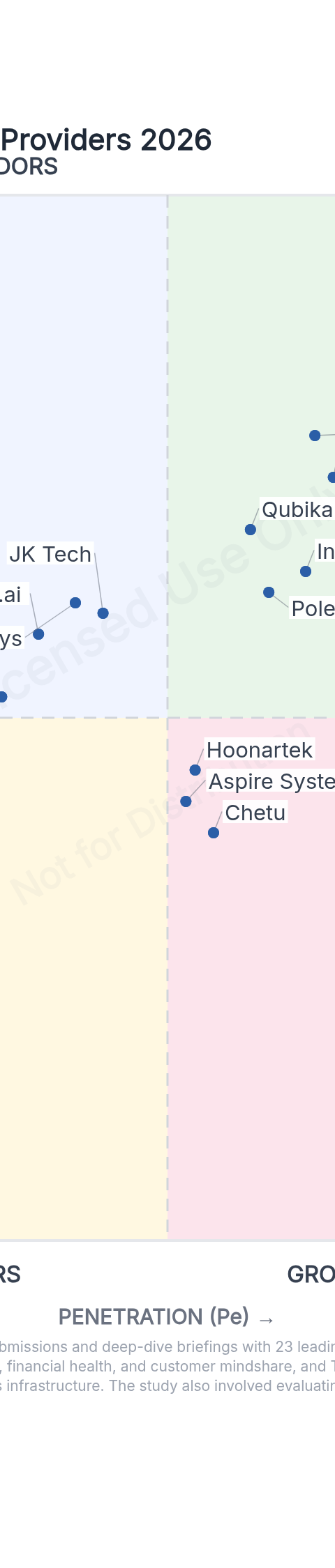
- 02 10 of 23 evaluated providers qualify as Leaders in 2026.
- 03 In 2026, leading data engineering service providers differentiate on lakehouse expertise, data contracts, observability, FinOps for data, and embedded AI/ML feature engineering — capabilities that directly shape downstream AI outcomes.
Why data engineering service providers matter in 2026
Modern data engineering is no longer just ETL. It spans real-time ingestion, governance, lineage, lakehouse architecture, dbt-driven transformations, and increasingly the data foundation for generative and agentic AI workloads.
We assessed dozens of data engineering service providers on delivery scale, platform partnerships (Databricks, Snowflake, Microsoft Fabric, BigQuery), reference customers, vertical depth, and ability to operate production data platforms — not just build them.
Choosing the right data engineering service provider determines how quickly your AI and analytics initiatives reach production. The wrong partner leads to brittle pipelines, runaway cloud bills, and shadow data estates.
In 2026, leading data engineering service providers differentiate on lakehouse expertise, data contracts, observability, FinOps for data, and embedded AI/ML feature engineering — capabilities that directly shape downstream AI outcomes.
Six things we score
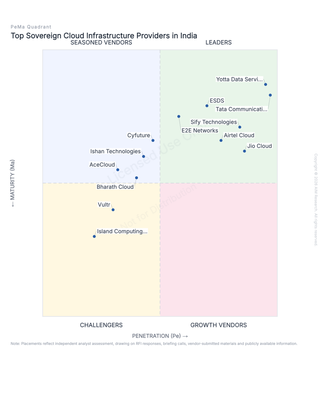
Our analysis is grounded in the PeMa Quadrant, AIM Research's framework that scores vendors on Performance and Market presence using primary research, customer interviews and capability deep-dives.
Delivery scale & track record
Proven engagements operating petabyte-scale platforms across regulated and high-volume industries.
Platform depth
Tier-1 partnerships and certified engineers across Databricks, Snowflake, Microsoft Fabric, GCP, and AWS data services.
Modern stack fluency
Hands-on with dbt, Airflow/Dagster, Iceberg/Delta, Kafka/Flink, and lakehouse-native governance.
AI-readiness
Capability to build feature stores, vector pipelines, and RAG-ready data foundations for GenAI/agentic workloads.
Operational excellence
DataOps maturity — observability, lineage, SLAs, on-call, and FinOps optimization.
Industry & regional fit
Vertical IP and ability to deliver across the Americas, Europe, India, and the GCC.
Top data engineering service providers (2026)
- 01Leaders
- 02Leaders
- 03Leaders
- 04Leaders
- 05Leaders
- 06Leaders
- 07Leaders
- 08Leaders
- 09Leaders
- 10Leaders
- 11AaysSeasonedSingapore
- 12Seasoned
- 13Seasoned
- 14Seasoned
- 15Seasoned
- 16Seasoned
- 17Growth
- 18Growth
- 19Growth
- 20Challengers
- 21Indus Net TechnologiesChallengersWest Bengal, India
- 22Konverge AIChallengersDelaware, US
- 23StratLyticsChallengersBhubaneswar, Odisha
Showing 10 of 23 ·
Common use cases
Migrating legacy warehouses
To a modern lakehouse on Databricks, Snowflake, or Fabric.
Building real-time event pipelines (Kafka, Flink, Kinesis)
For fraud detection or personalization.
Standing up a governed data mesh
With product-aligned domain teams.
Engineering RAG and feature pipelines
That feed generative AI and ML platforms.
Implementing data observability, lineage, and FinOps
To control cloud data spend.
Modernizing master data management (MDM) and customer data platforms (CDP)
Reports behind this guide
Get the data engineering service providers that fit your scope, budget and timeline
Frequently asked questions
What does a data engineering service provider do?
Data engineering service providers design, build, and operate the data pipelines, warehouses, lakehouses, and streaming systems that move data from source systems into analytics, ML, and AI applications.
How is data engineering different from data science?
Data engineering builds and runs the platforms and pipelines that produce reliable, governed data. Data science consumes that data to build models and generate insights. Most enterprises need both, often from the same partner.
Which platforms do leading providers specialize in?
In 2026, top providers cluster around Databricks, Snowflake, Microsoft Fabric, BigQuery, and AWS-native data services, typically with deep dbt, Airflow, Kafka, and Iceberg/Delta expertise.
How does AIM Research rank data engineering service providers?
We use the PeMa Quadrant — scoring vendors on Performance (delivery quality, technical depth, customer outcomes) and Market presence (scale, geographic reach, partnerships). Methodology details are on our PeMa Quadrant page.
How do I shortlist a data engineering service provider for an RFP?
Submit your requirements through AIM Research's RFP service. We match you with qualified providers based on your platform, vertical, region, and engagement model — typically within days.
Are these providers a fit for generative AI workloads?
Yes. The strongest 2026 providers also build the data foundations — vector stores, embeddings pipelines, feature stores, and RAG architectures — required for production generative and agentic AI.
Want an analyst to run this selection with you? Start a vendor selection