

The DPDP Act and RBI's data localization mandates have significantly increased the demand for sovereign cloud solutions in India.
Finding 1 of 5
PeMa Quadrant · 1st edition · Published September 30, 2026
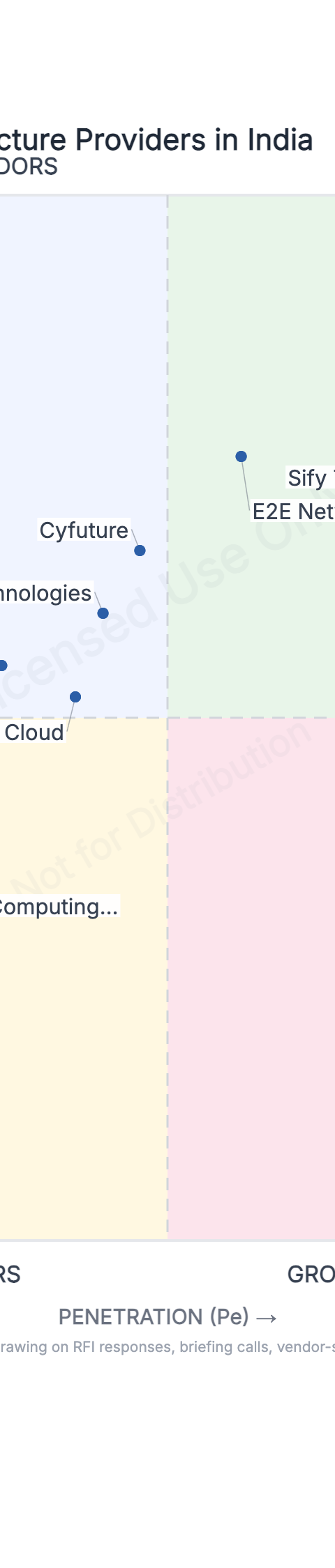
13 vendors evaluated on market penetration and technology maturity. 7 qualify as Leaders, and buyers should treat the placements as one input alongside their own RFP criteria, capability gaps and delivery needs.
13
Vendors evaluated
7
Leaders
First edition of this PeMa Quadrant.
7 Leaders · 4 Seasoned · 2 Challengers
Free for a limited time
Get the full report
Vendor profiles, scores and the full quadrant. Four quick fields.
The PeMa Quadrant
Hover a dot for the vendor, click to open its passport.
Market penetration →
What the report finds
The DPDP Act and RBI's data localization mandates have significantly increased the demand for sovereign cloud solutions in India.
Finding 1 of 5
Sovereign cloud offerings are built on existing infrastructure, with many providers launching or renaming services post-January 2025.
Providers define sovereignty differently, with data center operators focusing on physical control and AI clouds emphasizing isolation and platform control.
The Indian sovereign cloud market is fragmented, with no single cross-industry standard, placing the onus on buyers to define their requirements.
Sovereignty should be understood as controlled dependency rather than complete technological independence.
Vendors evaluated
| Vendor | Placement | Headquarters | Vendor passport |
|---|---|---|---|
| Airtel Cloud | Leaders | New Delhi | Passport → |
| E2E Networks | Leaders | Delhi NCR | Passport → |
| ESDS | Leaders | Nashik, Maharashtra | Passport → |
| Jio Cloud | Leaders | Navi Mumbai, Maharashtra | Passport → |
| Sify Technologies | Leaders | Chennai | Passport → |
| Tata Communications | Leaders | Mumbai | Passport → |
| Yotta Data Services | Leaders | Mumbai, Maharashtra | Passport → |
| AceCloud | Seasoned | Gurugram, Haryana | Passport → |
| Bharath Cloud | Seasoned | Hyderabad, Telangana | Passport → |
| Cyfuture | Seasoned | Noida, Uttar Pradesh | Passport → |
| Ishan Technologies | Seasoned | Ahmedabad, Gujarat | Passport → |
| Island Computing Services | Challengers | Bangalore, India | Passport → |
| Vultr | Challengers | Florida | Passport → |
Showing 10 of 13 ·
Abstract
AIM Research's annual report evaluates the top sovereign cloud infrastructure providers in India, focusing on companies that enable enterprises and government organizations to manage digital and AI workloads within Indian jurisdiction.
The report highlights the growing importance of sovereign cloud solutions due to regulatory changes such as the DPDP Act and RBI's data localization mandates. It emphasizes that while the concept of data residency is not new, the term 'sovereign cloud' encompasses broader dimensions including operational, legal, technical, supply-chain, and assurance sovereignty. The study assesses thirteen providers, considering their infrastructure, platform services, AI compute capabilities, and compliance with Indian regulations. The methodology involves a structured request for information, supplemented by analyst briefings and public records, to evaluate market penetration and technology maturity. The report identifies key market gaps, such as the need for a consistent definition of sovereignty and transparency in control-plane architecture, while also noting the emerging demand patterns from government and AI-focused enterprises. Overall, the report provides a comprehensive benchmark for assessing sovereign cloud providers in India.
Methodology
Note: Placements reflect independent analyst assessment, drawing on RFI responses, briefing calls, vendor-submitted materials and publicly available information.
X axis
Y axis
Note: Placements reflect independent analyst assessment, drawing on RFI responses, briefing calls, vendor-submitted materials and publicly available information.
Full report · PDF
Free for a limited time. The PDF arrives in your inbox.