

Governance and traceability are becoming paramount in BFSI AI services, with firms focusing on data modernization and context engineering.
Finding 1 of 5
PeMa Quadrant · 1st edition · Published August 18, 2026
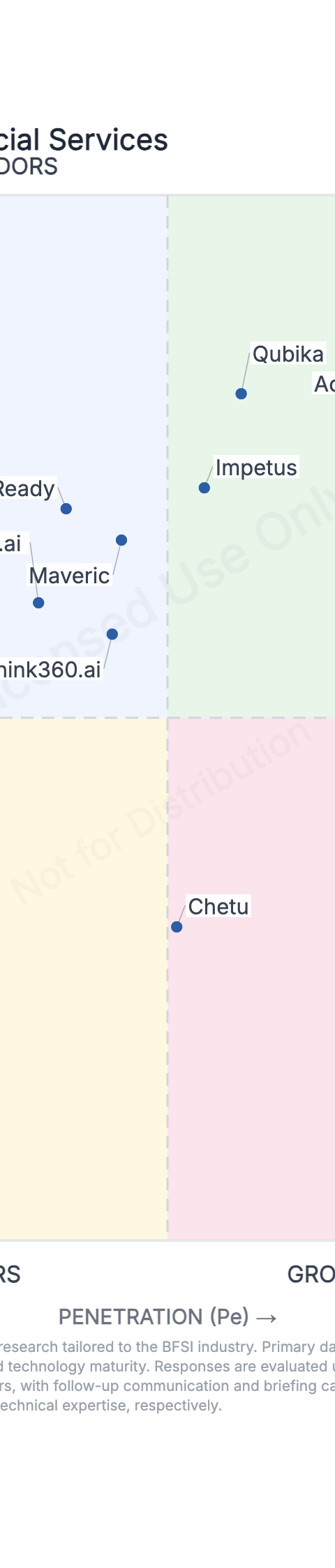
16 vendors evaluated on market penetration and technology maturity. 7 qualify as Leaders, and buyers should treat the placements as one input alongside their own RFP criteria, capability gaps and delivery needs.
16
Vendors evaluated
7
Leaders
First edition of this PeMa Quadrant.
7 Leaders · 6 Seasoned · 1 Growth · 2 Challengers
Free for a limited time
Get the full report
Vendor profiles, scores and the full quadrant. Four quick fields.
The PeMa Quadrant
Hover a dot for the vendor, click to open its passport.
Market penetration →
What the report finds
Governance and traceability are becoming paramount in BFSI AI services, with firms focusing on data modernization and context engineering.
Finding 1 of 5
Traditional AI remains crucial for predictive analytics and risk assessment, while GenAI and Agentic AI expand into document intelligence and workflow automation.
Proprietary platforms and reusable accelerators are central to AI delivery, offering domain-specific, governed workflows.
Data readiness and governance are essential for scaling AI initiatives beyond isolated pilots.
Dedicated AI practices and partnerships with cloud and technology providers support enterprise AI adoption.
Vendors evaluated
| Vendor | Placement | Headquarters | Vendor passport |
|---|---|---|---|
| Acuity Analytics | Leaders | London, UK | Passport → |
| EXL | Leaders | New York, NY, USA | Passport → |
| Genpact | Leaders | New York, USA | Passport → |
| Impetus | Leaders | Los Gatos, CA, USA | Passport → |
| Qubika | Leaders | Texas, United States | Passport → |
| Tavant | Leaders | Santa Clara, USA | Passport → |
| Tiger Analytics | Leaders | California, US | Passport → |
| Exponentia.ai | Seasoned | Mumbai, India | Passport → |
| Hoonartek | Seasoned | Union, New Jersey, US | Passport → |
| Maveric | Seasoned | Chennai, India | Passport → |
| Think360.ai | Seasoned | Mumbai, Maharashtra | Passport → |
| USEReady | Seasoned | New York, USA | Passport → |
| Zuci Systems | Seasoned | Dallas, USA | Passport → |
| Chetu | Growth | Sunrise, United States | Passport → |
| Ganit | Challengers | Tamil Nadu, India | Passport → |
| StratLytics | Challengers | Bhubaneswar, Odisha | Passport → |
Showing 10 of 16 ·
Abstract
The analyst report on AI Service Providers for Financial Services highlights the evolving landscape of AI services in the BFSI sector, focusing on the transition from traditional AI/ML to Generative AI and Agentic AI.
The study evaluates sixteen AI service providers based on delivery scale, financial health, growth, customer confidence, and company outreach, reflecting market penetration and technology maturity. Key findings indicate that governance and traceability are becoming paramount, with firms emphasizing data modernization, context engineering, agent orchestration, and outcome governance. Traditional AI remains crucial for predictive analytics and risk assessment, while GenAI and Agentic AI are expanding into document intelligence, customer assistance, and workflow automation. Proprietary platforms and reusable accelerators are central to AI delivery, with vendors increasingly offering domain-specific, governed workflows. The report underscores the importance of data readiness and governance in scaling AI initiatives and highlights the role of dedicated AI practices and partnerships in supporting enterprise AI adoption. The methodology involves primary and secondary research, with data collected through surveys and interviews, ensuring a comprehensive evaluation of vendor capabilities.
Methodology
The research methodology involves primary and secondary research tailored to the BFSI industry.
X axis
Y axis
The research methodology involves primary and secondary research tailored to the BFSI industry. Primary data is collected through surveys distributed among AI service providers, assessing factors like financial health, growth, and technology maturity. Responses are evaluated using standardized criteria, with scores normalized for comparison. The study includes a diverse sample of providers, with follow-up communication and briefing calls to ensure comprehensive evaluation. The Penetration and Maturity indices provide insights into market reach and technical expertise, respectively.
Full report · PDF
Free for a limited time. The PDF arrives in your inbox.