India’s GCC Opportunity: 50 U.S. Giants Poised to Enter the Market
This report is a refresh of the May 2025 GCC Watchlist report and analyzes and ranks U.S.-based companies that may establish Global Capability Centers (GCCs) in India over the next five years. The original study (published in May 2025) evaluated 209 Fortune U.S. 500 companies without an existing GCC presence in India at the time of publication.
Since the initial publication, seven companies from this 209-company universe have established or formally announced GCCs in India, reducing the current evaluation set to 202 companies. Notably, five of the Top 10 and seven of the Top 50 companies identified in the original watchlist have converted, validating the underlying scoring approach.
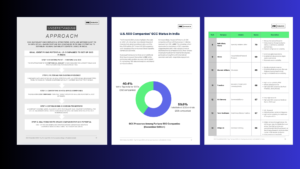
The analysis applies a structured scoring framework assessing global operational footprint, India presence, sector alignment with offshore capability models, and ownership structure. The findings indicate that companies with international operations and prior India engagement – particularly in financial services, healthcare and life sciences, technology-enabled industries, industrial manufacturing, and consumer-led sectors remain the most likely candidates for future GCC establishment.
The findings suggest that companies with international operations and some level of India engagement are more likely to explore GCC opportunities. Sectors such as financial services, healthcare and pharmaceuticals, technology-enabled industries, industrial manufacturing, and food retail show alignment with India’s GCC ecosystem in terms of workforce availability, operating costs, and scale.
The report aims to support industry groups, policy-makers, and consulting organizations in understanding potential areas of interest for future GCC development in India.
Top Sectors to Watch
The findings reveal that certain sectors stand out for their strategic fit with India’s GCC ecosystem:
- Financial Services: Increasing digitization and a demand for 24/7 operations make this a prime candidate.
- Healthcare and Pharmaceuticals: Global R&D needs and regulatory compliance work are driving interest in offshore talent hubs.
- Technology-Enabled Industries: Digital platforms, SaaS providers, and enterprise tech firms seek scale and innovation through India.
- Industrial Manufacturing: The shift toward Industry 4.0 and global supply chain management supports offshoring of engineering and design functions.
- Food and Retail: Back-office operations like supply chain analytics, procurement, and customer service are ripe for globalization.
Key Highlights:
1. Sector-Led GCC Penetration: GCC adoption is most concentrated in sectors like Commercial Banking, Semiconductors, Pharmaceuticals, Internet Services, and Industrial Machinery where functions such as R&D, analytics, engineering, and customer operations are deeply embedded in India.
2. Functional Evolution of India GCCs: Once dominated by IT support, India’s GCC landscape now spans risk management, regulatory compliance, design engineering, and innovation functions underscoring a shift from cost centers to capability hubs.
3. Emerging Industry Participation: Within the top 50 high-probability candidates for GCC establishment:
- 44% belong to Banking, Financial Services, Insurance (BFSI) and Healthcare sectors
- 28% fall under Retail, Food & Beverage, and Industrial Materials
- 12% represent Chemicals, Media/Entertainment, and Energy/Utilities
4. Lower GCC Likelihood in Select Sectors : Industries such as Tobacco, Railroads, Mining, Publishing, and Building Materials show limited GCC potential due to factors like high localization, regulatory constraints, or minimal offshorable functions.
5. Peer-Led GCC Expansion Patterns : Strong industry clustering indicates that peer adoption drives new entrants sectors with existing GCC density are more likely to attract additional players.
Strategic Implications:
For industry groups, this report offers a roadmap to engage with U.S. firms that are likely to enter the market. Policy-makers can tailor incentives and infrastructure strategies to attract these firms. Meanwhile, consulting organizations and real estate developers can target business development efforts toward sectors and firms that show high readiness.
The comprehensive list of all evaluated companies, along with a breakdown of their scores and strategic rationale, provides stakeholders with the insights needed to prioritize outreach and investment planning.
As the global business services model continues to evolve, India’s next wave of GCC growth may well be led by these 50 U.S. companies on the brink of expansion. The opportunity is not just to host operations but to co-create global transformation hubs for the future.
Table of Contents:
1. Key Highlights
2. Introduction
3. The India GCC Landscape of US Fortune 500 Companies
- U.S. Companies GCC Status in India
- Top 12 Industries with the Most GCC Penetration in India
4. Approach to Identifying Potential US companies to set up GCC in India
5. Scoring Framework : GCC Readiness Score
6. High Potential US firms most likely to establish GCC in India
- Top 50 Non GCC US companies list with high GCC establishing potential
7. GCC Watchlist Insights: Strategic Imperatives for Policy and Industry Leaders
8. Extended List: U.S. Firms Without Current GCC Presence in India
9. List of Fortune US 500 Companies having GCCs in India