
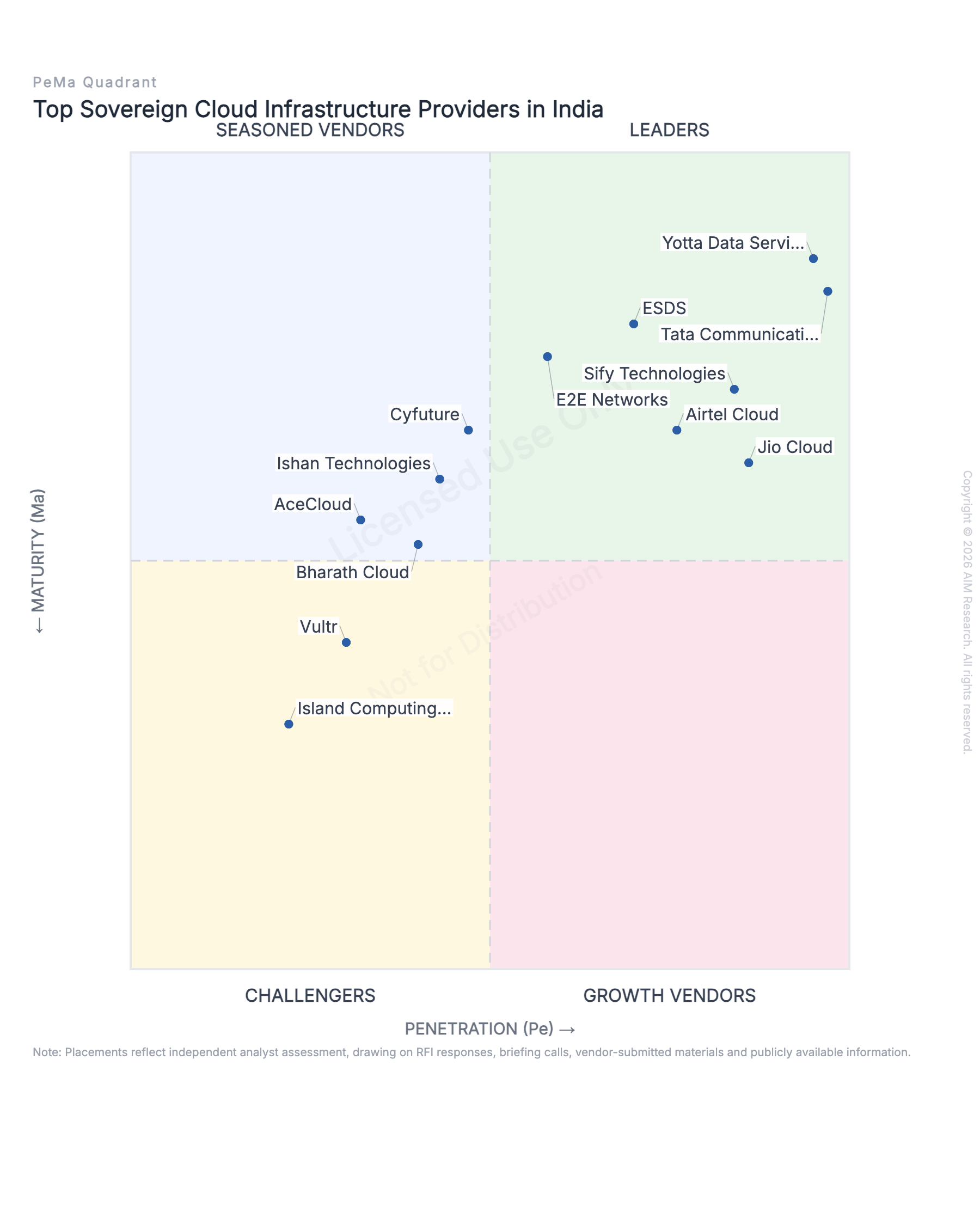
A total of 15 vendors are featured in the Agentic AI platform providers assessment.
Finding 1 of 5
PeMa Quadrant · 1st edition · Published March 9, 2026
15 vendors evaluated on market penetration and technology maturity. 7 qualify as Leaders, and buyers should treat the placements as one input alongside their own RFP criteria, capability gaps and delivery needs.
15
Vendors evaluated
7
Leaders
First edition of this PeMa Quadrant.
7 Leaders · 3 Seasoned · 2 Growth · 3 Challengers
Free for a limited time
Get the full report
Vendor profiles, scores and the full quadrant. Four quick fields.
The PeMa Quadrant
Hover a dot for the vendor, click to open its passport.
Market penetration →
What the report finds
A total of 15 vendors are featured in the Agentic AI platform providers assessment.
Finding 1 of 5
The market is transitioning from generative outputs to coordinated, multi-agent execution.
Persistent context and state management are emerging as core architectural differentiators.
Governance and compliance controls are embedded within runtime architecture.
Unified orchestration frameworks address enterprise production challenges.
Vendors evaluated
| Vendor | Placement | Headquarters | Vendor passport |
|---|---|---|---|
| Aisera | Leaders | Santa Clara, United States | Passport → |
| Freshworks | Leaders | San Mateo, United States | Passport → |
| Kore.ai | Leaders | Orlando, United States | Passport → |
| Moveworks | Leaders | Mountain View, United States | Passport → |
| SalesForce | Leaders | San Francisco, United States | Passport → |
| ServiceNow | Leaders | Santa Clara, United States | Passport → |
| Sierra | Leaders | San Francisco, United States | Passport → |
| Ema | Seasoned | San Francisco, United States | Passport → |
| Fractal Analytics | Seasoned | New York, United States | Passport → |
| SimplAI | Seasoned | San Francisco, United States | Passport → |
| Exotel | Growth | Bengaluru, India | Passport → |
| NiCE Cognigy | Growth | Düsseldorf, Germany | Passport → |
| Kasisto | Challengers | New York City, United States | Passport → |
| Teneo.AI | Challengers | Stockholm, Sweden | Passport → |
| Yellow.ai | Challengers | San Mateo, California, United States | Passport → |
Showing 10 of 15 ·
Abstract
The AIM Research report on Top Agentic AI Platform Providers 2026 evaluates 15 vendors based on penetration and maturity indices, derived from a combination of submitted RFI and secondary research.
The study highlights the transition from generative outputs to coordinated, multi-agent execution, with platforms designed to orchestrate specialized agents capable of planning, reasoning, and executing structured workflows. Key architectural differentiators include persistent context and state management, which support traceability and operational reliability. Governance and compliance controls are embedded within runtime architecture, integrating role-based access controls, policy enforcement mechanisms, audit trails, exception handling, and human oversight checkpoints. Unified orchestration frameworks address enterprise production challenges by integrating agents, data layers, workflow logic, monitoring, and execution controls within a single environment. The commercial models align with platform-led adoption, combining subscription-based and usage-based pricing with embedded engineering engagement models. The report also notes the expansion of domain-specific agent deployments and the primary application of Agentic AI platforms in customer service, IT service management, HR service delivery, sales lifecycle management, and financial operations.
Methodology
The research was conducted using a combination of submitted RFI by the participants and secondary research based on publicly available information.
X axis
Y axis
The research was conducted using a combination of submitted RFI by the participants and secondary research based on publicly available information. Vendors were evaluated based on penetration and maturity indices, which assess market adoption, reach, and service advancement. The study aims to provide an industry benchmark for evaluating Agentic AI platform providers.
Full report · PDF
Free for a limited time. The PDF arrives in your inbox.